
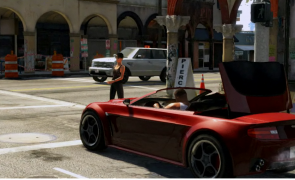
It seems like the whole world is waiting for Grand Theft Auto V. With the impending release of the latest installment in the legendary Grand Theft Auto series due September 17, Nick Rueben takes a trip down memory lane, recounting his relationship with the series and examining its appeal.
My first proper taste of the Grand Theft Auto series was at my friend Jay’s house. He had a Playstation 2 set up in his kitchen, and I watched, open-mouthed, as his leather jacketed counterpart beat a chubby police officer to the ground with a baseball bat. Ignoring his rising wanted level, and the sirens blaring in the background, Jay continued to stand over the cop, bludgeoning his lifeless corpse with the bat well to the point of overkill. It was a display of shocking, visceral violence and realistic in a way I’d never seen in a game before. It was also absolutely fucking hilarious.
For all the leaps the medium has been making recently in its ability to tell complex stories or create hauntingly beautiful worlds, for every Bioshock, Braid or Journey, sometimes all we want to do is run down fools in a stolen taxi to a soothing selection of 80’s classics. Grand Theft Auto knows this. It knows that despite yourself, you still love big guns, big boobs and big explosions. It knows you spend more time seeing how much destruction you can cause than playing through the story. It knows that deep down, like the young Ray Liotta in Goodfellas, you’ve always wanted to be a gangster.
With the trend of shoehorning morality systems into triple A titles, usually to add artificial depth to what are often weak narratives, it’s easy to get nostalgic about what Grand Theft Auto III offered players: A realistic and (at the time) visually striking world that let you unleash your inner Tony Montana whenever you felt like it. The only consequences were a few dollars and the loss of the precious weapon stash you’d been building up, and even then, only if you were stupid enough to get arrested or killed. No one was forcing you to block off the street with a truck, wait for the traffic to build up, then whip out your rocket launcher for a civilian barbecue, but the option was there if you wanted it. At the same time, if you were feeling charitable, you could spend hours saving lives in an ambulance. Not with the intention of gaining a few points for your morality meter, but simply because you felt like it (The sweet cash was a plus too.)
Grand Theft Auto touched upon a fundamental truth of gaming – as players, when we first start up the game, we’re all virtual sociopaths, free of any emotional attachment to the characters that populate the game world. It’s the game’s job to make us care about those people, to show us what effect our actions could potentially have on their fictional lives, and then challenge us to make a choice. What sort of story do we want to tell? What kind of events do we want to witness? Having to make moral decisions before a coherent world has been established just serves to alienate, and In a way that seems sadly missing from a lot of recent titles, there were no dialogue trees or ‘press a button to not be an arsehole’ prompts in GTA, just a populated, vibrant environment and a set of tools that let the player craft their own tale. Not a single zombie plague to discourage you from having fun in sight. (Cough, Dishonored, cough)
The next two entries in the Grand Theft Auto series built up on the formula III established, culminating in the mind bogglingly huge San Andreas. Abandoning the garish homage to Scarface era cinema that was Vice City, San Andreas marked a turn towards the mature storytelling that we’d see fully realised later on. The series’ cartoonish atmosphere was still present, but through the likeable C.J, we were given an underdog to root for. Suddenly it wasn’t just about making a name for ourselves in the big city, but about seeing a character we cared about out of a bad situation. It’s worth noting how critical San Andreas’s opening hours, inspired by films like the Friday series and Menace to Society, were to letting the player build a bond with CJ .By showing us the character go about his normal life, and his relationship with his friends and family, it made it all the more poignant and jarring when the proverbial shit hit the fan.
A lot of gamers took issue with Grand Theft Auto IV’s switch toward gritty realism over cartoon violence, and satire over goofy comedy. Unscripted mayhem was still an option, but admittedly, the game felt a little restricted after the plethora of options offered in its predecessor. Still, if nothing else, the game gave us Niko Bellic.
Slightly dodgy Eastern-European accent aside, the charismatic Bellic was a joy to play, and what was effectively a thirty-hour interactive Scorsese film wouldn’t have been the same without him. There’s always the risk of alienating players by giving the protagonist a fleshed out personality and back story, but Rockstar let us relate with Bellic on a very important level. Like him, we’re strangers in a strange land, and the ironies of Liberty City aren’t lost on either of us. Grand Theft Auto IV’s vision of modern America seems just as ridiculous and hypocritical to Bellic as it does to us, and we’re given the opportunity to experience it completely in tandem with our in-game counterpart. It’s a great trick on the part of Rockstar, and even though the game wasn’t quite what we’d come to expect from the series, the presentation and world building were second to none. Personally, I got completely sucked in, ate all my meals watching the in-game TV shows, and found myself going to press a non-existent ‘Y’ button by parked cars on the way to work the next day. I’m quite impressionable like that though.
Needless to say, the upcoming release of Grand Theft Auto V has got me a little bit excited. Rockstar North clearly doesn’t rush games, and if Red Dead Redemption is anything to go on, we’re in for an absolute treat. What about you guys? What are your favourite moments from the series, and what features would you like to see return in the next instalment?
 00
00


Add One