

This is the first in a series of pieces that will occasionally run on Hostile Gamer about video game development, authored by Carlos Martinez.
I’m sure that most of the people who read this blog are avid gamers. And of those avid gamers, many have wanted, at one point or another, to make their own video games. It might even be your ideal job: Everything is pink and beautiful; you, at one with your muse; your ideas instantly translating into a sea of interactive playable goodness… It’s all about living the pixelated dream. Or is it?
When you finally decide it’s time to take the plunge and make video games, you start to notice that not everything is all “flowers of moe”. This series of articles will be a reflection of my own experiences as a developer. Hopefully it will help provide direction to those of you out there who are considering taking this long yet fulfilling road.
Where do you start?
So you’ve made your choice. You will become a developer! You will fulfill your childhood dream of making great games for everyone to play, knowing that one day you shall be remembered for those inspiring creations that delivered hours, days, weeks, and even months of fun to people all over the globe. So… Now what? Where do I start? How do I make vidyagaemz!?
So many roads, so many choices, so much which could go wrong… Right?
WRONG! It might be difficult to start, and you (and I) still have a lot to learn. However, you must not be discouraged by what’s ahead. If others can succeed, then you can too.
You might be thinking, “Yeah, yeah, that’s really inspiring but… How do I start?”
- First, determine your objectives:
You cannot hope to simply “work in the video game industry”. You need to determine what kinds of games you want to make. Then you need to assess what’s required. You need to assess your own knowledge and skills, and fight to “level up” yourself.
You can read about the industry in magazines and on blogs to get a sense of the different types of video games that are being made, and what people are looking for. You can find job descriptions that list what sorts of skills game development studios are looking for. And you can review college websites that specialize in game development to see the kinds of skills the industry requires. These are just a few out of many possible resources. The more diligent you are, the more you’ll be able to find and draw upon.
Then make a list. At the top should be the kinds of video games you want to make and/or what kinds of job you would want to find in the industry. Then divide the rest of the page into two columns. On the left hand side should be a list of the skills needed to make the kind of game/get the kind of job you want. On the right hand side should be a list of the skills you currently possess.
You may be daunted by how much is on the left-hand side, and how little is on the right-hand side. Don’t be. Don’t look at the process as a bunch of subjects to be memorized. Game development requires learning by doing.
Now start by going back in time, back to a time when video games were made of one to five levels and your only objective was to rack-up points through the simplest of tasks.
Set yourself to make a simple game. A Tetris clone would be a good start. Personally, I made a crappy Space Invaders clone in Multimedia Fusion. After that, I started learning C# and made a prototype of a text-adventure game that sadly never got completed.

Chimbo Invaders!
As you can see in the image, the game doesn’t look that amazing, though it actually took a whole day of work to complete it. But the important thing is that it got me going. Get a game engine that doesn’t need coding knowledge like RPG Maker and see if you are able to commit and you enjoy what you do. Try making a simple, short game…just something to give you some momentum.
As a side note: the sprite I initially used for the baddies was lost, so for this example I took a virus sprite made by Tim Rocks. All credits go to him for that one sprite.
- Take it or leave it

When all this is taking place is when you start asking yourself: “Is it for me?” Making a game takes a whole lot of work and dedication, even if you have a whole team working with/for you. The question is: Will you still do it? Will you spend countless days and nights learning, planning, working to make your dream come true? And what if it fails and people hate it? Will you be able to live with it and improve?
And what if you have a team? Will they commit? Will they take the blame with you? Will they learn from it?
Being a developer takes a strong constitution. It means that it is time to stop playing human and start playing God, creating your own world where you make the rules.
- Study, Study, Study!!!

You’ve thought about this a lot, you’ve had a taste of what it’s like. Now, you are ready to give it your all.
Grab a few books about Game Development, Coding, Graphic Design, Level Design, and/or Sound Engineering. Take as many subjects as you wish, but make sure that you commit to the ones you choose.
If you want to make games professionally, you must know coding, as it is a key factor in Game Development. Algebra is highly recommended too. No matter if you’re a designer or a programmer, you must at least know what’s going on inside the code.
This is a tricky step because it is likely that you will find very outdated information. My advice is to ask someone more experienced or join a community. gamedev.net is a very good choice if you seek help and books, and 3DBuzz.com is an amazing site where they will teach you how to code specifically for Game Development. You can take 3-D modeling and animation courses as well.
- Pick an engine, learn it, and begin!

You’ve done it. All that time and effort of studying is finally going to pay off. You realize that all your life you have been coasting along as if you were in a dream. Suddenly, facing the trials of the last few months, you have come alive.
There are many free game engines that you can use to make professional games that you may also license and sell, such as Unreal Engine 3 and Unity3D. I recommend the latter due to its friendly interface and low learning curve.
Once you pick one, you must sit down and learn to use it. This shouldn’t take you very long, but it depends on how complicated your engine of choice is. It also depends on whether the engine is made to work with big teams or small ones.
- Summarizing:
1. Assess what you want to produce and what it takes to produce it.
2. Make a simple game with a game engine that requires little or no coding knowledge to familiarize yourself with the field (like RPG Maker or Game Factory/Multimedia Fusion).
3. If you like it, learn to code in a language of your preference, as well as the rules of making a game professionally.
4. Pick a game engine that allows you to make professional games. Assemble your team, and start making the game.
Making video games is hard. Of that there’s no doubt. But nothing will beat that sense of accomplishment when you see people playing and enjoying your creation. You’ll be able to look back and say: “I’ve done things the hard way. But without taking risks, taking responsibility for failure… how could I have understood?”
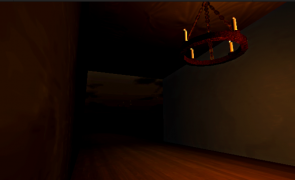
As for me, I’m currently working on a little game in Unity3D. It is a horror game with a surreal atmosphere, it’s still in very early stages but I hope to complete it eventually. I’ll leave some screenshots below.
NOTE: If you’re interested in checking out Chimbo invaders you can download it HERE


 00
00


Add One